
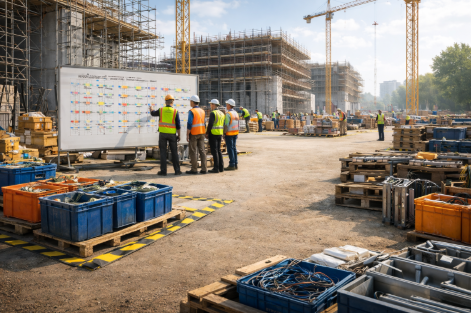
Why “busy” does not mean that the project is running smoothly
Many construction projects appear productive from the outside: lots of people involved, busy sites, ongoing deliveries. Nevertheless, delays, rework, and conflicts arise. Often, the cause is not a lack of performance, but a lack of work rhythm: the cycle is missing.
Cycle planning is a central approach from lean construction for synchronizing processes across trades and zones. When implemented correctly, it reduces waiting times, prevents material bottlenecks, and stabilizes cooperation.
HSC is not a standard consulting firm. As a project stabilizer with leadership and lean DNA, we therefore focus first on execution stability – and only then on optimization.
What does “cycle planning” mean in construction?
Cycle planning structures execution as a recurring rhythm:
- The project is divided into zones/sections
- Trades follow in a defined order
- Cycle times define when a change takes place
- Handover points are clearly described (“finished” is verifiable)
The goal is not to prevent every deviation. The goal is to create a common frame of reference that enables control in everyday life.
Typical symptoms when the cycle is missing
1) Waiting times
Trades wait for space approvals, equipment, materials, or decisions.
2) Material jams
Material is delivered “on suspicion” and blocks paths and areas. This results in restacking, searching, and additional transport.
3) Blaming
Unclear handovers and dependencies lead to delays being personalized (“it’s the others‘ fault”) instead of addressing the causes in the system.
The most common causes behind the symptoms
- No clear zoning or batches that are too large
- Excessive parallelism (WIP)
- Lack of make-ready logic (starting without prerequisites)
- Logistics not synchronized with demand on the construction site
- No routine for deciding on blockers (obstacles are discussed, not solved)
Step by step: How to implement cycle planning in practice
Step 1: Define zoning & handover criteria
A zone must be divided in such a way that a trade can deliver within the cycle time. Define what “finished” means (e.g., surface, cleanliness, inspections, approvals).
Step 2: Set cycle time & sequence
Start pragmatically. The cycle time does not have to be perfect, but stable enough to function as a rhythm.
Step 3: Introduce mandatory make-ready
Requirements are checked before starting:
- Material available and correctly picked
- Area free and accessible
- Equipment and personnel planned
- Approvals/plan status clear
- Safety requirements met
If anything is missing, do not start – otherwise you are just shifting the problem.
Step 4: Synchronize project logistics
Link logistics to the cycle:
- Delivery windows matching the cycle sequence
- Defined routes and storage areas
- Consciously choose a buffer strategy (where, how much, for what)
- Kitting/picking for cycle-synchronized provision
Step 5: Establish control routines
- Daily (15 min): Decide on blockers (owner, deadline, next step)
- Weekly: Agree on commitments, measure reliability, limit WIP
Metrics: How to control without KPI overload
Recommended core set:
- PPC (Percent Plan Complete): Reliability of commitments
- WIP / Number of parallel fronts: System load
- Blocking time / Waiting time: Productivity loss due to obstacles
- Delivery reliability / Delivery quality: Quality of logistics to meet demand
Risks and trade-offs
- Takt without make-ready increases stress and rework.
- Too many exceptions render the takt ineffective.
- Takt without logistics synchronization remains theory.
- Too rapid introduction without guidance and training can generate resistance.
Conclusion
Takt planning is not a “planning format” but an operating model for reliable execution. Those who consistently combine takt, make-ready, and blocker decisions reduce waiting times, decongest material flows, and depersonalize conflicts.
Schreibe einen Kommentar