
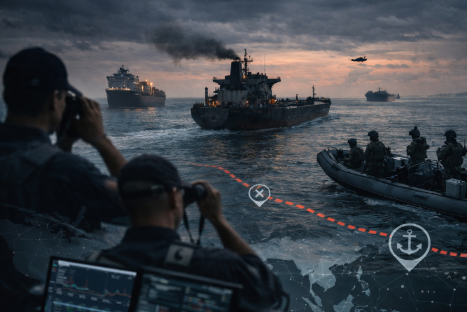
Maritime client projects are often still structured as if uncertainty could be sorted into individual categories. There is the route, the port, the ship, the client, the deadline, and the compliance issue. For each topic, there are responsibilities, lists, and approvals. What is often missing is the crucial element: the integrated view.
This gap becomes particularly apparent when it comes to shadow fleet, port, and corridor risks. UNCTAD describes a maritime world in which key chokepoints like the Suez Canal, the Panama Canal, and the Red Sea are more sensitive to geopolitical tensions, conflicts, and climate impacts. The EU describes shadow fleet structures as covert networks of aging tankers that operate using, among other things, disabled tracking systems, false flags, and complex ownership structures. OFAC identifies additional warning signs such as successive STS transfers, manipulated AIS data, and problematic documentation. At the same time, according to the IMO, Port State Control can ensure that ships are inspected more thoroughly, delayed, or detained in ports.
The operational implication is clear: maritime client projects require a risk management framework that jointly assesses the ship, port, corridor, and counterparties. Those who fail to do so often only recognize risks once execution is already underway.
The first lever is a risk gate before contractual commitment. Even before a project is finalized in terms of price or schedule, a brief, binding check should take place. It covers corridor stability, port profile, ship history, ownership and management structure, flag, insurability, certificates, document plausibility, and alternatives. This is not over-regulation, but protection against later improvisation.
The second lever is ongoing monitoring. UNCTAD explicitly identifies improved early warning systems as an area for action. Companies should therefore define which signals trigger a reassessment: for example, security incidents, regulatory changes, unusual movement patterns, massive congestion, or new information about involved vessels and counterparties.
The third lever is a Vessel-and-Port Verification Pack. It consolidates the information that truly matters in an emergency: identity, recent port calls, documentation status, AIS plausibility, insurance status, and red lines for approval or stoppage. OFAC’s guidelines make it clear that precisely these areas are relevant in practice.
The fourth lever is leadership. A project does not automatically benefit from good data. It only benefits when good data leads to quick decisions. That is why fixed escalation levels, designated responsible parties, and maximum response times are needed.
Measurement should also remain pragmatic. Four key metrics are sufficient for a solid overview: the percentage of projects with a completed Risk Gate, the percentage of port calls with a complete Verification Pack, the time to a Go/No-Go decision, and the rate of anomalies resolved prior to execution.
It would be dishonest to gloss over the drawbacks. Yes, this approach creates additional verification effort. Yes, it can slow down coordination and occasionally produce false alarms. But that is precisely where the gain in maturity lies: companies pay a manageable price in preparation to avoid a significantly higher price during operations.
The HSC perspective fits this very well. HSC is not a run-of-the-mill consultant that masks complexity with PowerPoint slides. The more productive approach is: first stabilize execution, then improve the organization. For maritime client projects, this means first creating transparency and decision-making capability at the critical points—ship, port, corridor, counterparties. Afterward, processes, standards, and KPI systems can be developed sustainably.
Maritime risks will not disappear. But they can be identified earlier, managed more clearly, and mitigated more effectively. This is precisely the difference between a formally planned project and one that is actually under control.
Schreibe einen Kommentar