
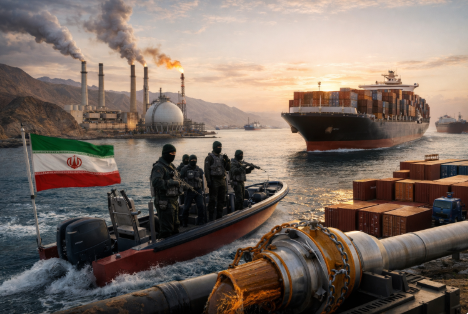
Anyone looking at the Strait of Hormuz today and thinking to themselves, “Another supply chain crisis already,” is missing the point. This is precisely one of the most dangerous misconceptions of 2026: the notion that the current situation can be managed using the routines from 2021.
2021 was primarily a crisis of overload. The pandemic collided with globally distributed production, fluctuating demand, lockdowns, and scarce capacity. The ECB describes significant bottlenecks in Europe between September 2020 and December 2021. At that time, the disruption was widespread. There was a shortage of intermediate goods, transport capacity, and reliability—almost everywhere at once.
In 2026, we see something different. In March 2026, the IEA refers to the largest supply disruption in the history of the global oil market. This is remarkable because it shows that today’s bottlenecks are concentrated in a few, extremely critical locations. Hormuz is one such location. In 2024, around 20 percent of global LNG trade passed through there. A disruption in this corridor affects not only crude oil markets, but also power systems, the chemical industry, industrial processes, and freight networks.
The second difference from 2021 is the interdependence of risks. The IMF and UNCTAD have already demonstrated for the Red Sea and Suez that rerouting significantly extends transit times. A route like Shenzhen–Rotterdam, which takes about 31 days via Suez, could suddenly take around 41 days via the Cape of Good Hope. Added to this are higher costs, greater uncertainty, and longer capital tie-ups. A recent IMF paper even shows that additional delays can have a measurable impact on inflation. The global economy is thus already in a state of reduced resilience even before Hormuz.
Europe exacerbates this dynamic in a particular way. Politically, reducing dependence on Russian gas was necessary. Operationally, however, it does not automatically mean greater stability. The European Commission projects a decline in Russian gas imports from 45 percent in 2021 to 19 percent in 2024. At the same time, Eurostat reports that by 2024, 45.3 percent of EU LNG imports will already come from the United States. The IEA describes a tense environment in 2025 and an all-time high in Europe’s LNG imports. Europe’s vulnerability has not ended—it has shifted from the rigid risk of pipeline dependence to a more fluid, global market and route risk.
For companies, this results in an uncomfortable but clear agenda.
First: Make critical exposure visible. Don’t just maintain supplier lists; understand routes, energy intensity, alternatives, and response times.
Second: Consolidate operational leadership. A fixed rhythm between procurement, production, logistics, energy, sales, and finance prevents information from moving faster than decisions.
Third: Rebalance inventory and contract design. Greater security is not a panacea, but for critical components it is often more sensible than later emergency cost escalation.
Fourth: Manage with a few KPIs. Exposed spend, days of cover, event-to-decision time, and margin sensitivity are often sufficient to turn uncertainty into leadership.
This is also where HSC’s DNA comes into play. In such situations, HSC does not act as a standard consultancy that speaks abstractly about resilience. Rather, it acts as a project stabilizer with leadership and lean DNA: first calm the execution, clarify responsibilities, establish rhythm—and only then improve. Because optimization on an unstable foundation is rarely progress. Most often, it is merely better-organized chaos.
Of course, trade-offs arise. Capital is tied up. Variant diversity increases. Efficiency metrics may look worse in the short term. But that is precisely what mature resilience is: not the illusion of free security, but the conscious decision to increase one’s capacity to act.
2026 is not 2021. And those who take this seriously—not just rhetorically, but operationally—will not prevent every crisis. But they will be caught off guard by it less often.
Schreibe einen Kommentar