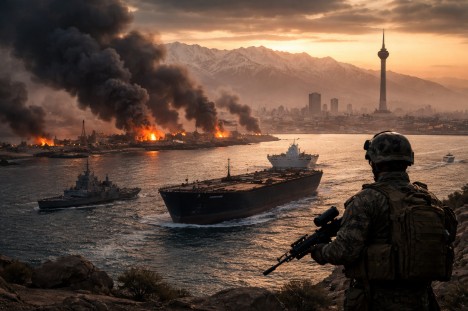
As of March 2, 2026 (Europe/Berlin) – The situation surrounding Iran, Israel/USA, and the regional security architecture remains highly dynamic. But it is precisely at times like these that it is worth taking a sober look at what is often overlooked: Not every serious military conflict ends with a change in the political system.
And it is precisely this scenario – conflict without change in Tehran – that could be the more significant long-term development for the Middle East.
The basic assumption: War can end – the logic remains
When a state is hit hard militarily but no new order emerges politically, the result is rarely a “return to normality.” More often, a permanent state of high tension arises, in which each side learns from the conflict – and repositions itself accordingly.
For the region, this means less hope for rapid détente and more focus on deterrence, control, and risk management.
More deterrence, less room for diplomacy
Without a change of system, Tehran (or a successor from the existing power apparatus) will see the conflict as proof that the survival of the system is at stake. This makes negotiations more difficult:
- concessions appear as weakness in domestic politics
- in foreign policy, the expectation of having to respond “toughly” increases
Consequence: Diplomacy remains possible – but it becomes more technical, more tenacious, and more dominated by security logic.
Proxy conflicts remain – and become more unpredictable
Even if individual structures are weakened, the pattern remains the same: asymmetric options via partner groups and indirect means. On the contrary: after severe blows, more decentralized structures often emerge – less controllable, but capable of action.
Consequence: More “gray zone” conflict (drones, missiles, cyber, sabotage), less clear front lines.
Israel–Lebanon–Iraq: Multi-front stress becomes the norm
Without change in Tehran, the likelihood increases that the region will slip into a rhythm of escalation peaks: short, intense escalations – then fragile calm again – then again.
Consequence: The security situation will not be permanently “good,” but permanently fragile.
Nuclear threshold and arms race: Deterrence as a lesson
When a system survives despite being under massive pressure, the classic lesson is: “We need stronger deterrence.”
This can mean:
- A stronger focus on threshold capability (not necessarily an immediate bomb, but “quickly achievable”)
- More mistrust of inspections/agreements
- More pressure on neighbors to expand their own security options
Consequence: The Middle East becomes strategically more “nuclear” – even without a formal escalation threshold.
Strait of Hormuz: The risk premium remains permanent
Even limited disruptions are enough to:
- Drive up insurance premiums
- Extend delivery times
- Add risk premiums to oil and gas prices
Consequence: Energy and transport costs become structurally more volatile – with effects extending to construction, industry, food prices, and public budgets.
Domestic policy: “Fortress mode” instead of reform
If no change is achieved, the result is often not openness, but consolidation:
- a stronger role for security apparatus
- tighter controls
- loyalty checks among the elite and in administration
Consequence: An Iran that has hardened its domestic policy usually acts not more moderately, but more calculatedly – and more willing to take risks – toward the outside world.
What does this mean for decision-makers in politics and business?
Something that always applies in crises proves its worth here: Robust routines beat wishful thinking. Those who are prepared retain freedom of action.
For politics & institutions
- Secure de-escalation channels (military & diplomatic)
- Plan maritime security as an ongoing task
- Strengthen regional emergency coordination (energy, evacuation, infrastructure)
For companies and supply chains
- Define alternative routes and trigger plans (think Suez/Red Sea/Hormuz in tandem)
- Update insurance and contract clauses (force majeure, delivery times, price escalation clauses)
- Multi-sourcing for critical components and energy-intensive items
Conclusion: No regime change does not mean “status quo” – but a more expensive, tougher status quo
If the conflict ends without a new political order emerging in Iran, the Middle East is likely to remain in a permanent state of deterrence, proxy dynamics, and economic risk premium.
The good news is that those who now establish clear standards, crisis processes, and resilience will gain something that is worth its weight in gold in this region – the ability to act.
FAQ
What does “Iran conflict without regime change” mean?
It means that the conflict will have military consequences, but the political system in Tehran will remain in place or reorganize itself within the same power structure.
Why would that be particularly critical for the region?
Because deterrence, proxy conflicts, and Hormuz risks would remain “priced in” in the long term – politically and economically.
What are the biggest economic risks?
Transportation and insurance surcharges, volatile energy prices, supply chain disruptions, and investment reluctance.
Schreibe einen Kommentar