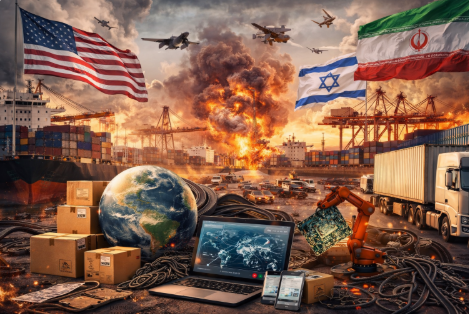
The reflex is understandable: When the conflict between the US, Israel, and Iran escalates, companies first look at the price of oil. But this view is too narrow. For geopolitical escalation rarely affects supply chains solely through energy prices. It affects networks, decisions, and the ability to ensure operational stability amid uncertainty.
The Strait of Hormuz is a prime example of this. In 2024 and the first quarter of 2025, more than a quarter of global seaborne oil trade, around a fifth of global oil and petroleum consumption, and about a fifth of LNG trade passed through it. UKMTO currently assesses the threat situation in the Strait of Hormuz and the Arabian Gulf as critical; the IMO insists on the protection of civilian shipping and freedom of navigation.
For companies, this means that even a prolonged state of uncertainty can be enough to strain supply chains, insurability, capacities, and on-time delivery. A crisis does not even have to completely close a corridor to trigger massive knock-on effects. It is enough for predictability to be lost.
Exactly this dynamic was already observable in the Red Sea. According to the IMF, trade through the Suez Canal fell by 50 percent in the first two months of 2024 compared to the previous year. UNCTAD has since described more volatile freight rates and a maritime situation in which rerouting around the Cape of Good Hope is altering entire time windows and schedules.
The problem, then, is bigger than an energy price shock. It is a test of organizational maturity.
In many companies, the same weaknesses become apparent under pressure: Critical components are not clearly prioritized. Exposed relationships lack transparency. Decisions are approved too late. Sales, procurement, and logistics operate with differing situational assessments. It is precisely then that uncertainty tips over into operational instability.
That is why operational stabilization is the first step. HSC takes a clear stance here: Do not perfect the vision of the future first; instead, secure execution first. This order sounds simple, but it is crucial in a crisis environment.
In practice, this means four things.
First, a robust criticality analysis is needed. Materials, customers, suppliers, and transport corridors must be assessed based on the impact of failure, lead time, and substitutability.
Second, a cross-functional crisis team with frequent coordination is required. Supply chain, procurement, production, sales, and finance need a shared situational overview and clearly defined escalation thresholds.
Third, targeted decoupling is required. Buffers should be created where the network would otherwise break down: for critical items, long-lead-time components, regulatory-sensitive goods, or strategic customers.
Fourth, honest customer communication is essential. Communicating new priorities, realistic commitments, and alternative scenarios early on protects trust better than overly optimistic promises.
The effectiveness of these measures can be measured. Suitable KPIs include ETA reliability on critical routes, days of supply for critical items, the proportion of revenue or procurement at risk, and the time from risk identification to decision-making.
Of course, there are trade-offs. Greater resilience costs money. Higher inventory levels tie up capital. Secondary sources and alternative routes increase effort and often unit costs as well. However, those who shy away from these costs usually end up paying the price for instability later on.
The U.S.-Israel-Iran conflict should therefore not be viewed merely as a foreign policy escalation or an energy issue. It serves as a litmus test for how resiliently companies are actually organized in a world of overlapping crises.
Those who react only to prices are addressing the symptom.
Those who strengthen execution, transparency, and decision-making quality are addressing the root cause.
That is where true resilience begins.
Schreibe einen Kommentar